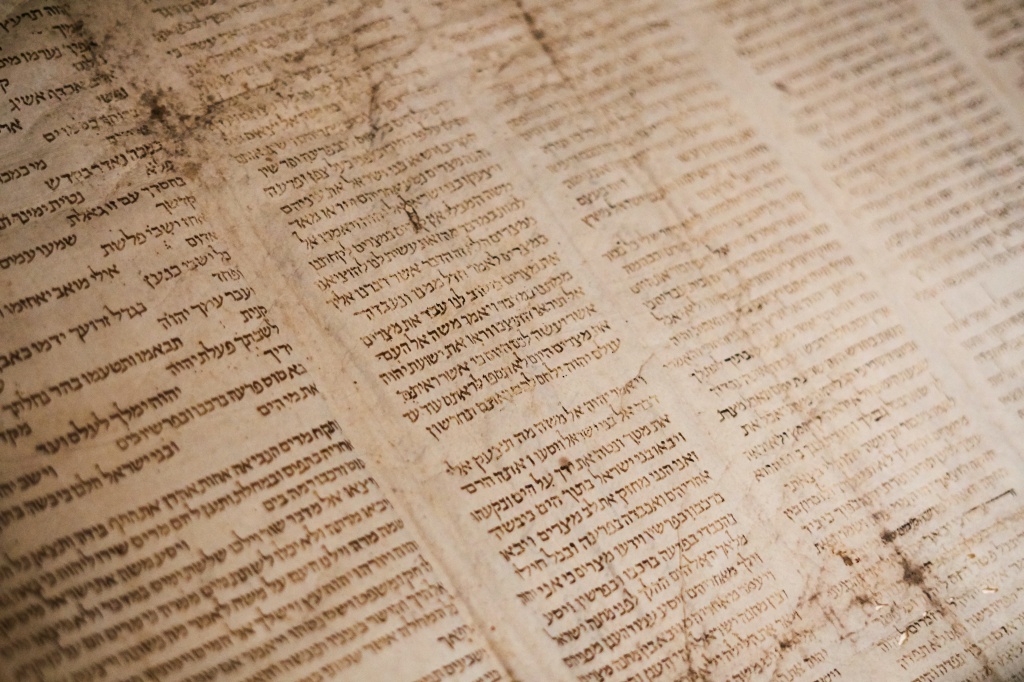
To show the reliability of the Old Testament, the approach is slightly different from that for the New Testament, given the distance between the time of the author and the earliest available copies.
A common misconception is that the text of the Old Testament was passed down over many generations, primarily orally, and therefore has been prone to a shift in message. In reality, the Jewish people placed a huge amount of importance in the careful copying of their scriptures by educated scribes, whose primary task was to make copies of Scripture.
One fact which gives us a high confidence in the accuracy of transmission of the Old Testament is the fact that when a manuscript was copied, scribes would perform a numerical calculation of occurrences of each letter on the page to ensure the text was preserved. Copies that failed to match the expected totals were destroyed and the process would start again.
While this copying process was used by the Masoretes between the 7th and 10th centuries AD, until recently these were the oldest manuscripts of the Old Testament available to us. The discovery of the Dead Sea Scrolls in 1948 however, put the earliest copies of the Old Testament back to 200 years before Jesus, confirming the accuracy of Scripture. Of the manuscripts found in the caves at Qumran, in particular a complete copy of the book of Isaiah shows the amazing accuracy of how the Old Testament text was copied. Alongside Isaiah are manuscripts and fragments from every Bible book other than Esther, with Deuteronomy and the Psalms particularly being well represented1.
Of course, for us as Christians, Jesus’ own view of the Old Testament text in the 1st Century affirms the Old Testament in his day was unchanged. Key verses to show your Muslim friend would be John 10:35, where Jesus stated that “Scripture cannot be broken”, Matthew 5:18, where Jesus affirms that the Law cannot be changed2, and Matthew 15:3, Mark 7:13 and Matthew 22:31, where Jesus identifies Scripture as the word and command of God. Jesus also quoted and referred back to Scripture on many occasions. See, for example, Matthew 21:16, Matthew 12:3, Luke 17:29, Luke 17:32, Luke 11:51, Mark 12:26 and John 6:31–51.
When Jesus talked with the two disciples on the road to Emmaus, he also affirmed that the whole of Scripture was uncorrupted when, “beginning with Moses and all the Prophets, he explained to them what was said in all the Scriptures concerning himself” (Luke 24:27). Jesus also makes a similar claim when talking with the Jewish leaders in John 5:39.
If he called them gods, to whom the word of God came (and the Scripture can’t be broken), John 10:35
One verse that Muslim apologists often use to undermine confidence in the Old Testament is Jeremiah 8:8, which at first glance suggests a flawed process of the transmission of the Torah. This verse talks about the “lying pens of the scribes”; handling the Law of the Lord falsely.
It is important however to understand that a scribe’s role was not solely copying Scripture, but also interpreting Scripture and drafting legal documents like marriage, divorce, loans, inheritance, mortgages, the sale of land and the like.
In Jeremiah 26:4-5 God declares that the Law was “clearly set before” his people. How could God expect his people to walk according to his word if it had become corrupted and was not available to them in pristine form?
Also, the wider context of Scripture, especially the book of Daniel, shows that the Law was available in its original form beyond Jerusalem. Daniel who was exiled in Babylon had access to Jeremiah’s prophecy (see Daniel 9:1-3) and shows in his response in Daniel 9:11-13 that he must have had access to the text of the Law. Otherwise, how else would he have known in what ways Israel would have sinned against the Lord, even to the point where he is able to declare, “as it is written in the law of the Lord”?
Later too, we are told in Nehemiah 8:8 that Ezra and the Levites would read the book of the Law and explain it to those who had returned from exile, some 70 years after God’s people were taken into Babylon.
Of course, as stated in a previous approach (Before Muhammad, After Muhammad?), the Quran affirms the reliability of the Scriptures in Muhammad’s day many times, and so any Muslim claiming that the Bible has been corrupted has to deal with the contradiction this raises.
“‘How do you say, “We are wise, and the LORD’s law is with us?” But, behold, the false pen of the scribes has made that a lie. Jeremiah 8:8
When it comes to the Old Testament, Jesus shows us that not only is it reliable, but also that it is all about him. Luke 24 is a good place to take your Muslim friend and show them that according to Jesus, his death and resurrection is firmly rooted in “the Law of Moses, the Prophets and the Psalms” (see Luke 24:44-49) and be ready to take your friends to Genesis 22:1-19 (the testing of Abraham), Exodus 12:1-13 (the Passover), Psalms 22:1-31 (an explicit foretelling of the cross in the Psalms) and Isaiah 53:1-12 (a prophecy of the Gospel in the Prophets), to show them what Jesus was referring to.
But on the first day of the week, at early dawn, they and some others came to the tomb, bringing the spices which they had prepared. They found the stone rolled away from the tomb. They entered in, and didn’t find the Lord Jesus’ body. While they were greatly perplexed about this, behold, two men stood by them in dazzling clothing. Becoming terrified, they bowed their faces down to the earth. The men said to them, “Why do you seek the living amongst the dead? He isn’t here, but is risen. Remember what he told you when he was still in Galilee, saying that the Son of Man must be delivered up into the hands of sinful men and be crucified, and the third day rise again?” They remembered his words, returned from the tomb, and told all these things to the eleven and to all the rest. Now they were Mary Magdalene, Joanna, and Mary the mother of James. The other women with them told these things to the apostles. These words seemed to them to be nonsense, and they didn’t believe them. But Peter got up and ran to the tomb. Stooping and looking in, he saw the strips of linen lying by themselves, and he departed to his home, wondering what had happened. Behold, two of them were going that very day to a village named Emmaus, which was sixty stadia from Jerusalem. They talked with each other about all of these things which had happened. While they talked and questioned together, Jesus himself came near, and went with them. But their eyes were kept from recognising him. He said to them, “What are you talking about as you walk, and are sad?” One of them, named Cleopas, answered him, “Are you the only stranger in Jerusalem who doesn’t know the things which have happened there in these days?” He said to them, “What things?” They said to him, “The things concerning Jesus the Nazarene, who was a prophet mighty in deed and word before God and all the people; and how the chief priests and our rulers delivered him up to be condemned to death, and crucified him. But we were hoping that it was he who would redeem Israel. Yes, and besides all this, it is now the third day since these things happened. Also, certain women of our company amazed us, having arrived early at the tomb; and when they didn’t find his body, they came saying that they had also seen a vision of angels, who said that he was alive. Some of us went to the tomb and found it just like the women had said, but they didn’t see him.” He said to them, “Foolish people, and slow of heart to believe in all that the prophets have spoken! Didn’t the Christ have to suffer these things and to enter into his glory?” Beginning from Moses and from all the prophets, he explained to them in all the Scriptures the things concerning himself. They came near to the village where they were going, and he acted like he would go further. They urged him, saying, “Stay with us, for it is almost evening, and the day is almost over.” He went in to stay with them. When he had sat down at the table with them, he took the bread and gave thanks. Breaking it, he gave it to them. Their eyes were opened and they recognised him; then he vanished out of their sight. They said to one another, “Weren’t our hearts burning within us while he spoke to us along the way, and while he opened the Scriptures to us?” They rose up that very hour, returned to Jerusalem, and found the eleven gathered together, and those who were with them, saying, “The Lord is risen indeed, and has appeared to Simon!” They related the things that happened along the way, and how he was recognised by them in the breaking of the bread. As they said these things, Jesus himself stood amongst them, and said to them, “Peace be to you.” But they were terrified and filled with fear, and supposed that they had seen a spirit. He said to them, “Why are you troubled? Why do doubts arise in your hearts? See my hands and my feet, that it is truly me. Touch me and see, for a spirit doesn’t have flesh and bones, as you see that I have.” When he had said this, he showed them his hands and his feet. While they still didn’t believe for joy, and wondered, he said to them, “Do you have anything here to eat?” They gave him a piece of a broiled fish and some honeycomb. He took them, and ate in front of them. He said to them, “This is what I told you while I was still with you, that all things which are written in the law of Moses, the prophets, and the psalms concerning me must be fulfilled.” Then he opened their minds, that they might understand the Scriptures. He said to them, “Thus it is written, and thus it was necessary for the Christ to suffer and to rise from the dead the third day, and that repentance and remission of sins should be preached in his name to all the nations, beginning at Jerusalem. You are witnesses of these things. Behold, I send out the promise of my Father on you. But wait in the city of Jerusalem until you are clothed with power from on high.” He led them out as far as Bethany, and he lifted up his hands and blessed them. While he blessed them, he withdrew from them and was carried up into heaven. They worshipped him and returned to Jerusalem with great joy, and were continually in the temple, praising and blessing God. Amen. Luke 24